TL;DR
- Check Point has released a fix for a high-severity flaw in its security gateways. Attackers used it to take over unpatched appliances and, in some incidents, wipe VMware hosts.
- The flaw is CVE-2026-123039, a local privilege escalation in Gaia OS. CISA added it to the Known Exploited Vulnerabilities catalog on Friday, November 13.
- Federal civilian agencies have until Monday, November 16, to apply the fix. CISA encourages every organization to do the same.
- Attackers chained it with PHP2Shell on internet-facing Mobile Access portals. A hotfix for PHP2Shell has been available since October 23.
- Install the November Jumbo Hotfix for your version. Then check the gateway for signs of earlier compromise.
Check Point has released a fix for a high-severity flaw in its security gateways. Attackers used that flaw to take over unpatched appliances. In some incidents they also wiped VMware hosts. The Cybersecurity and Infrastructure Security Agency added the issue to its Known Exploited Vulnerabilities catalog on Friday, November 13. Federal civilian agencies have until Monday, November 16, to apply the fix. CISA encourages every organization to do the same.
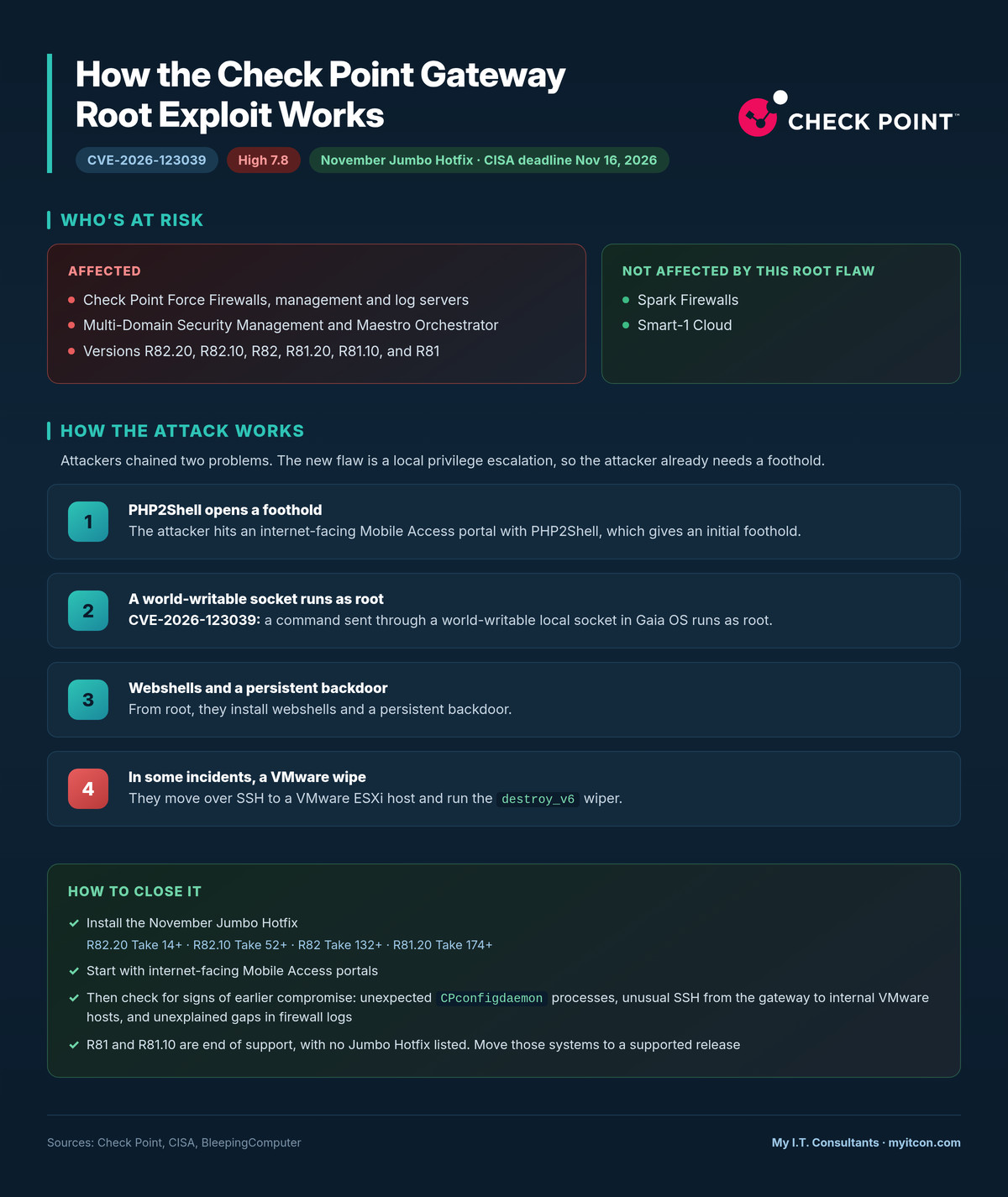
The new issue is tracked as CVE-2026-123039. It is a local privilege escalation in Gaia OS, which runs on Check Point gateways and management servers. An attacker who already has a foothold on the appliance can send a command through a world-writable local socket. The system then runs that command as root. Check Point rated the flaw 7.8 out of 10.
This follows the PHP2Shell story we covered on October 21. Check Point Research said attackers chained the two problems. They first used PHP2Shell against internet-facing Mobile Access portals. They then used this new flaw to reach root. From there they installed webshells and a persistent backdoor. In some observed incidents, they moved over SSH to a VMware ESXi host. They then ran a wiper called destroy_v6.
Check Point said a hotfix for PHP2Shell had been available since October 23. The company said it observed the exploit against a couple of dozen customers. Exploitation activity was seen from October 30 through November 4.
The November Jumbo Hotfix closes both holes. It applies to Check Point Force Firewalls, management and log servers, Multi-Domain Security Management, and Maestro Orchestrator. The affected versions are R82.20, R82.10, R82, R81.20, R81.10, and R81. Spark Firewalls and Smart-1 Cloud are not affected by this root flaw. R81 and R81.10 are end of support, with no Jumbo Hotfix listed. Those systems need to move to a supported release.
The fixed takes are Take 14 or later for R82.20, Take 52 or later for R82.10, Take 132 or later for R82, and Take 174 or later for R81.20. Until the hotfix can be installed, Check Point says administrators can stop the dynamic_server process and prevent it from restarting. That workaround disables some Dynamic CLI commands.
Ask your IT provider whether you run any of these Check Point products. If you do, install the Jumbo Hotfix. Start with internet-facing Mobile Access portals. After the update, have your provider confirm the fix is actually in place. On a patched system the local control socket is no longer world-writable. Also review the gateway for signs of earlier compromise. Check Point recommends looking for unexpected CPconfigdaemon processes, unusual SSH from the gateway to internal VMware hosts, and unexplained gaps in firewall logs.
The fix is available now. Businesses that apply it and check for earlier compromise can close this door.
Lindale businesses can ask veteran-owned My I.T. Consultants in Athens for a Free Assessment. Call 903-675-5431. Our office hours for hourly work are Monday through Friday from 7:00 a.m. to 6:00 p.m. Contract customers can reach us 24/7.
Want help with this at your business? See Cybersecurity on our Services page or contact My I.T. Consultants.
Image: My I.T. Consultants, with official Check Point logo