TL;DR
- On November 17, someone published two malicious versions of agent-framework, the Python package for the Microsoft Agent Framework, to PyPI. The bad releases were 1.26.1 and 1.26.2.
- PyPI quarantined each release in less than an hour. Version 1.26.0, released November 12, is the last clean release.
- Each bad release added a .pth startup file, so the credential stealer ran whenever Python started, even if no one imported the framework.
- It went after Azure, Azure DevOps, Git, Docker, and Hugging Face secrets, and 1.26.2 added GitHub Actions identity tokens. Wiz said at most 50 requests were captured at the attacker's free webhook.site address.
- Anyone who installed either version should pin to 1.26.0, rebuild affected environments, rotate reachable secrets, and review Azure sign-in logs.
A trusted developer package briefly turned into a credential thief on November 17. Someone published two malicious versions of agent-framework to PyPI, the main public registry for Python software. Agent-framework is the Python package for the Microsoft Agent Framework, which developers use to build SI agents. The bad releases were versions 1.26.1 and 1.26.2. PyPI quarantined each of them in less than an hour.
The package is widely used. Wiz said it gets almost 200,000 downloads a month. Version 1.26.0, released November 12, is the last clean release. A Microsoft maintainer confirmed on GitHub that the compromised versions were removed. The maintainer said an investigation was underway. The root cause has not been confirmed.
The attack worked through a small startup file. Each bad release added a .pth file to the site-packages folder. Python runs those files every time it starts. That meant the stealer ran even if no one imported the framework. Researchers at Wiz and StepSecurity said it collected secrets from environment variables and credential files. It targeted Azure CLI logins, Azure DevOps tokens, Git credentials, Docker settings, and Hugging Face tokens. It also requested fresh Azure managed-identity tokens. Version 1.26.2 added theft of GitHub Actions identity tokens. Everything went to a public webhook.site address.
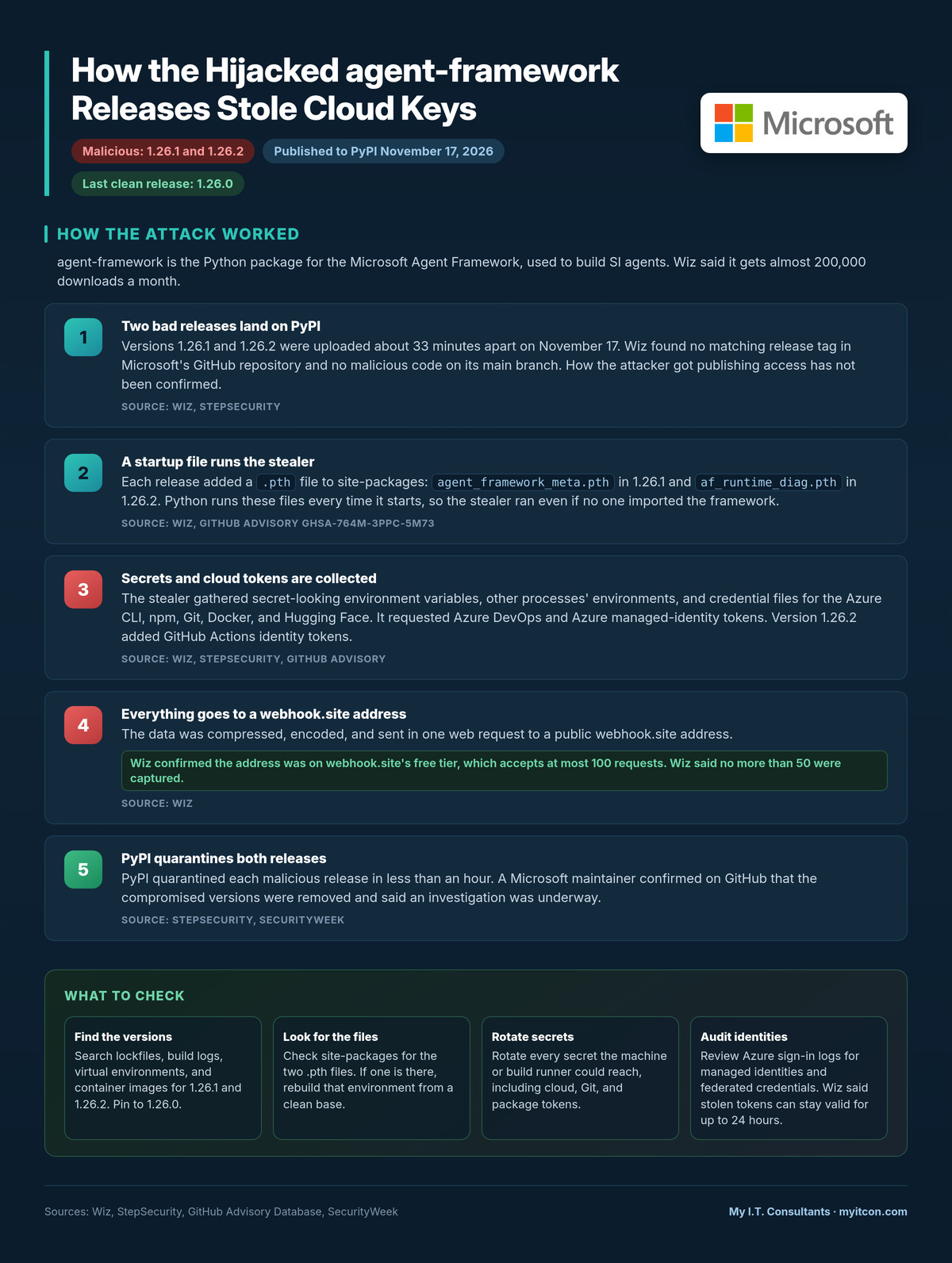
There is some good news in the details. Wiz confirmed that the attacker used a free webhook.site address. That free tier accepts at most 100 requests. Wiz said no more than 50 requests were captured. Those requests could still hold working cloud keys. Teams that installed either version should act quickly.
The cleanup steps are clear. Search lockfiles, build logs, virtual environments, and container images for versions 1.26.1 and 1.26.2. Pin the package to 1.26.0. Look in site-packages for agent_framework_meta.pth or af_runtime_diag.pth. If either file is there, rebuild that environment from a clean base. Rotate every secret the machine or build runner could reach. Review Azure sign-in logs for managed identities and federated credentials tied to those systems. Wiz noted that stolen tokens of this kind can stay valid for up to 24 hours.
Frankston businesses can ask veteran-owned My I.T. Consultants in Athens for a Free Assessment. As a Microsoft-certified MSP, we can review your Azure identities, build pipelines, and developer tools for exposure. Call 903-675-5431. Our office hours for hourly work are Monday through Friday from 7:00 a.m. to 6:00 p.m. Contract customers can reach us 24/7.
Want help with this at your business? See Cybersecurity on our Services page or contact My I.T. Consultants.
Image: My I.T. Consultants (SI-generated illustration), with the Microsoft logo identifying the company in the story. No endorsement implied.