TL;DR
- On November 17, Oracle and the OpenJDK project released fixes for CVE-2026-114938, a critical Java flaw that its finder, Calif, nicknamed Java4Shell. CISA urged organizations to patch it immediately.
- The bug is in Java's Base64 decoder. CISA said crafted input could crash the Java runtime and could allow remote code execution without a login.
- It affects OpenJDK 17.0.6 and newer, including builds such as Oracle Java SE, Temurin, and Corretto, on x86-64 servers with AVX-512 VBMI. Java on ARM is not affected.
- Qualys said it had not seen public confirmation of attacks in the wild as of November 17.
- Update to a fixed build, such as 17.0.21.1, 21.0.13.1, 25.0.5.1, or 27.0.1.1, and restart every Java process. Start with internet-facing sign-in, build, and collaboration servers.
Java has a serious new security flaw. The good news is that the fix is already out. On November 17, Oracle and the OpenJDK project released updates for a bug tracked as CVE-2026-114938. The security firm Calif, which reported the bug, nicknamed it Java4Shell. The same day, CISA urged organizations to patch it immediately.
The flaw lives in the code that decodes Base64. Base64 is a common format for login headers, tokens, and file uploads. CISA said specially crafted Base64 input could crash the Java runtime. It said the same input could also allow remote code execution without a login. JFrog's researchers explained that a stray padding character makes the decoder write past the end of its memory buffer.
Only some systems are exposed. The bug affects OpenJDK 17.0.6 and newer, including Java 21, 25, and 27. It also reaches builds based on OpenJDK, such as Oracle Java SE, Eclipse Temurin, and Amazon Corretto. The server must also run on an x86-64 processor that supports a feature called AVX-512 VBMI. Qualys said that includes recent Intel Xeon and AMD EPYC chips. Java on ARM processors is not affected.
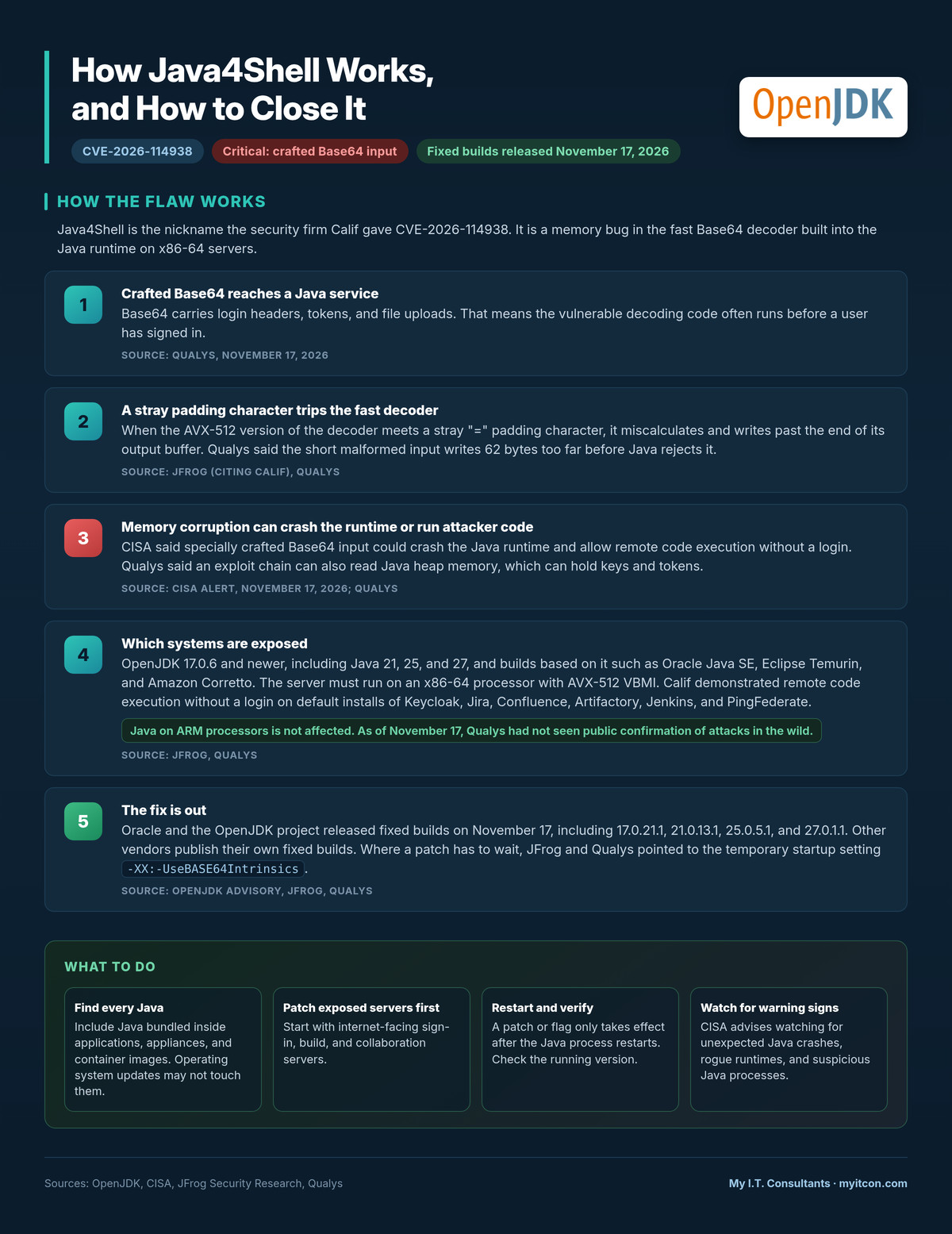
Calif said it reached remote code execution on default installations of several popular products. Qualys listed Keycloak, Jira, Confluence, Artifactory, Jenkins, and PingFederate among the products reachable without a login. As of November 17, Qualys said it had not seen public confirmation of attacks in the wild. The researchers are holding back their product-specific exploits for now.
Protection is straightforward. Update Java to a fixed build, such as 17.0.21.1, 21.0.13.1, 25.0.5.1, or 27.0.1.1. Other Java vendors publish fixes on their own schedules. Check each vendor's advisory for its fixed build. Many applications bundle their own copy of Java. Operating system updates may not touch those copies. If a patch has to wait, JFrog and Qualys pointed to a temporary startup setting, -XX:-UseBASE64Intrinsics. Restart every Java process after patching, because the fix only takes effect on restart. Start with internet-facing sign-in, build, and collaboration servers.
Brownsboro businesses can ask veteran-owned My I.T. Consultants in Athens for a Free Assessment. We can help find the Java runtimes in your servers and applications and confirm they are patched. Call 903-675-5431. Our office hours for hourly work are Monday through Friday from 7:00 a.m. to 6:00 p.m. Contract customers can reach us 24/7.
Want help with this at your business? See Cybersecurity on our Services page or contact My I.T. Consultants.
Image: My I.T. Consultants (SI-generated illustration), with the OpenJDK logo identifying the project in the story. No endorsement implied.