TL;DR
- SANS Internet Storm Center reported on Monday, November 16, that its honeypots started seeing exploit attempts against LiteLLM over the weekend.
- The requests try to chain a LiteLLM command-injection flaw (CVE-2026-42271) with a Starlette Host-header flaw nicknamed BadHost (CVE-2026-48710). Together they can run commands with no login.
- Both flaws are already in CISA's Known Exploited Vulnerabilities catalog. CISA added the LiteLLM flaw on June 8, 2026, and the Starlette flaw on September 2, 2026.
- The chain is closed by upgrading LiteLLM to 1.83.7 or later and Starlette to 1.0.1 or later, then rebuilding and redeploying the service.
- Until you can patch, block the two MCP test endpoints, review logs for unusual Host headers, and rotate provider credentials stored by the proxy.
SANS Internet Storm Center reported on Monday, November 16, that its honeypots started seeing exploit attempts over the weekend. The requests targeted LiteLLM, an open-source SI gateway that many teams use to reach model providers. Handler Johannes Ullrich said the traffic appears to chain two known flaws. Those flaws can let an attacker run commands on the gateway with no login.
The first flaw is CVE-2026-42271. In LiteLLM versions 1.74.2 through 1.83.6, two MCP preview endpoints accepted a full server configuration in the request. That configuration included the command to run. LiteLLM then spawned that command as a subprocess on the proxy host. The vendor advisory says a valid proxy key was the only gate. Even a low-privilege internal-user key was enough.
The second flaw is CVE-2026-48710, known as BadHost. It sits in Starlette, the Python web framework under LiteLLM's proxy. Versions 1.0.0 and earlier did not validate the Host header before rebuilding the request URL. Access checks that trust that rebuilt path can be bypassed. Horizon3.ai showed that this removes the key requirement. The two flaws together become unauthenticated remote code execution.
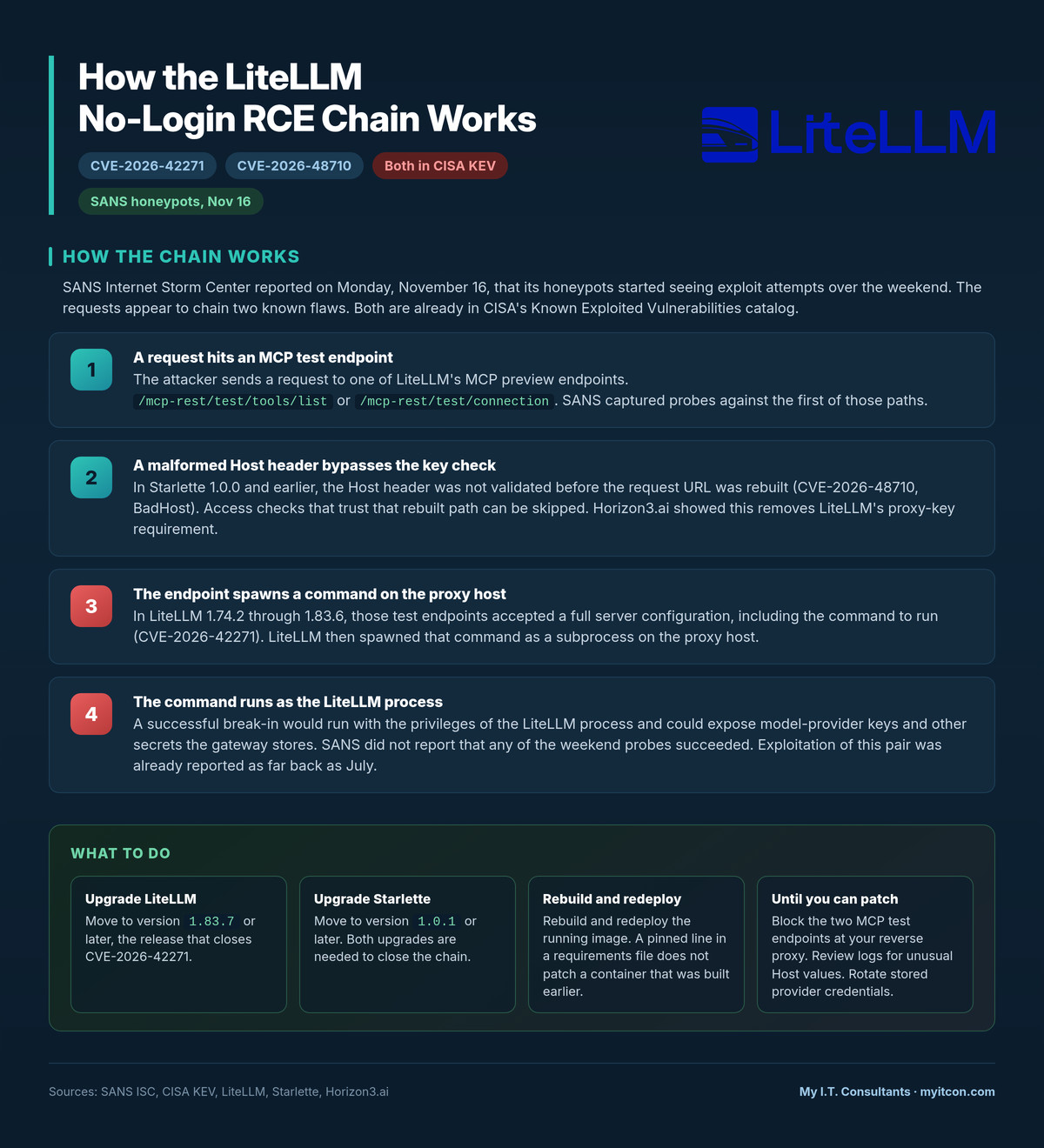
CISA had already listed both vulnerabilities in its Known Exploited Vulnerabilities catalog. It added the LiteLLM flaw on June 8, 2026. It added the Starlette flaw on September 2, 2026. Ullrich also noted that exploitation of this pair was reported as far back as July. The weekend scans are a fresh wave, not a new bug. Some of the Host values used bracket characters. Ullrich read that as an attempt to slip past filters built around earlier public examples.
A successful break-in would run as the LiteLLM process. It could expose the model-provider keys and other secrets the gateway stores. SANS did not report that any of these weekend probes succeeded. The captured requests used a simple identity command as a test.
The upgrades are available now. Upgrade LiteLLM to version 1.83.7 or later. Upgrade Starlette to version 1.0.1 or later. Rebuild and redeploy the running image. A pinned line in a requirements file does not patch a container that was built earlier. If you cannot patch immediately, block POST requests to /mcp-rest/test/connection and /mcp-rest/test/tools/list at your reverse proxy. Review logs for unusual Host header values. Also watch for unexpected subprocess activity. Rotate the provider credentials stored by the proxy. A later LiteLLM release, 1.84.0, also closes a separate authentication flaw that CISA has listed in the same catalog.
Canton businesses that run SI tools or gateways can ask veteran-owned My I.T. Consultants in Athens for a Free Assessment. As a Microsoft-certified MSP, we can review whether those services are patched and how they are exposed. Call 903-675-5431. Our office hours for hourly work are Monday through Friday from 7:00 a.m. to 6:00 p.m. Contract customers can reach us 24/7.
Want help with this at your business? See Cybersecurity on our Services page or contact My I.T. Consultants.
Image: My I.T. Consultants, with the official LiteLLM logo identifying the vendor in the story.