TL;DR
- Since November 18, GreyNoise, watchTowr, Cloudflare, and Previdian have reported exploitation attempts against Java4Shell (CVE-2026-114938). None has confirmed a successful break-in so far.
- Working exploits exist privately at VulnCheck and Immersive, and attackers are already hiding their scanning tools.
- CISA had not added the flaw to its Known Exploited Vulnerabilities catalog as of its November 18 update.
- Red Hat says affected systems are vulnerable out of the box. Keycloak, Atlassian, Jenkins, Cisco, Elastic, and Siemens have published advisories, though some fixes are still coming.
- Update to OpenJDK 17.0.21.1, 21.0.13.1, 25.0.5.1, or 27.0.1.1, or the equivalent patched build from your vendor. Include any bundled copies of Java, then restart the process and confirm the running version.
Attackers have started going after Java4Shell. Within two days of the November 17 fixes, several security firms reported exploitation attempts against CVE-2026-114938, the critical OpenJDK flaw in Java's Base64 decoder. None of them has confirmed a successful break-in so far. That gives businesses a short window to finish patching before the attacks improve.
GreyNoise had recorded more than 150 requests shaped like a Java4Shell attack by early November 19, SecurityWeek reported. The requests came from five IP addresses. GreyNoise said it had not seen a successful intrusion on its sensors. The firm Previdian logged nine exploitation attempts from six IP addresses on November 18 and 19. It cautioned that its sensor data cannot show whether any target was compromised.
watchTowr is seeing the same trend. Jake Knott, its head of threat intelligence, said attackers are hitting its honeypots with requests labeled "java4shell-recon." He said attackers are also sending blind exploitation attempts with correctly shaped requests. Knott said the activity is not very functional yet. He expects attackers to build more reliable exploits for specific products over the coming days.
Cloudflare's Cloudforce One team noticed that some scanners are already hiding their tools. In one case, an IP address probed a target with a user agent that named Java4Shell. Roughly 17 hours later, the same address came back with the exploit trigger while posing as the Chrome browser. On November 18, Cloudforce One also saw one IP address used for both Java4Shell and ARTEX activity. ARTEX is an open-source SI penetration testing tool that attackers have been abusing to automate intrusions.
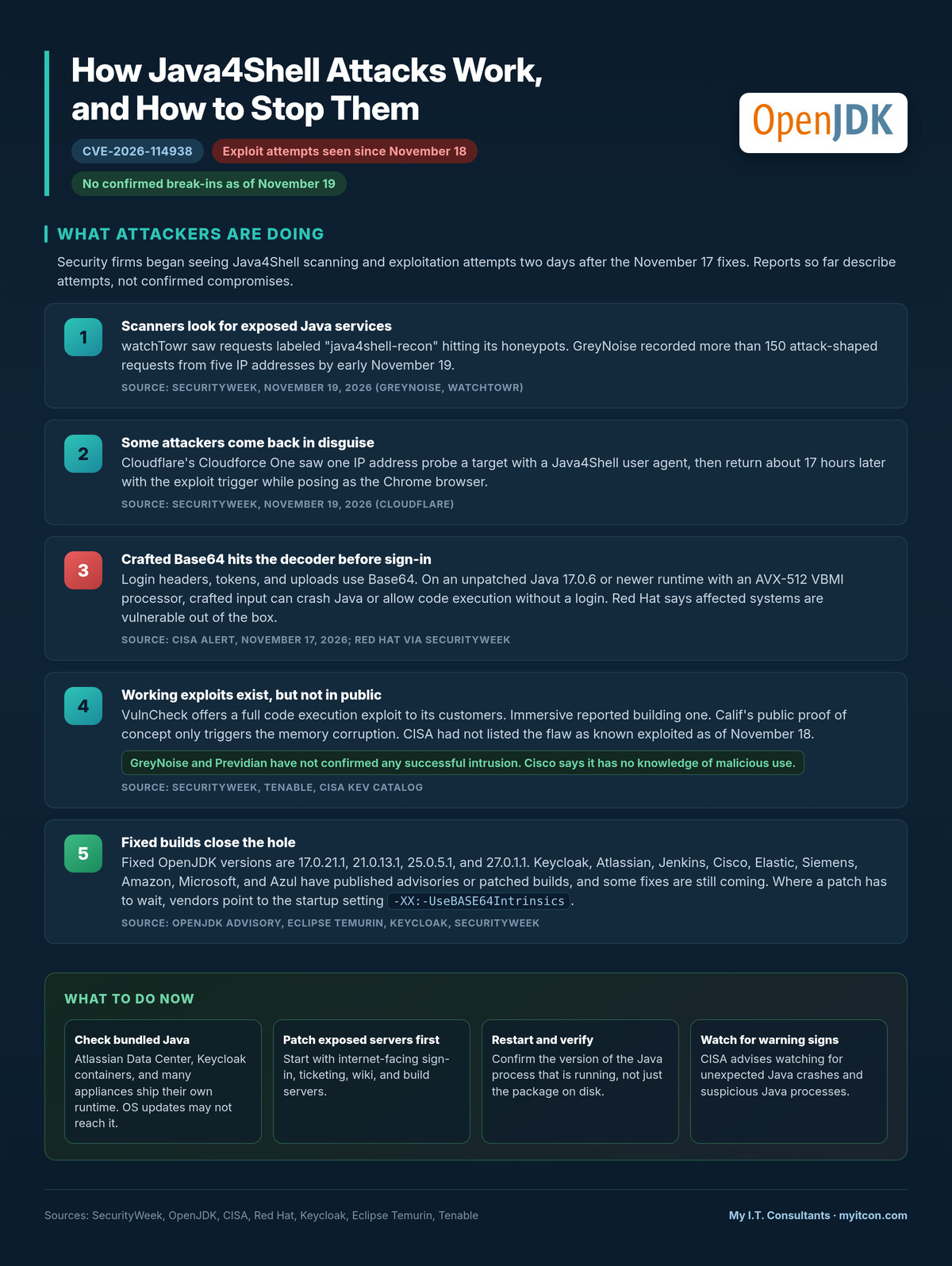
Working exploits exist, but they are not public. VulnCheck said a full remote code execution exploit is available to its customers. Kevin Breen of Immersive reported that his team built a working exploit. The proof of concept that Calif published only triggers the memory corruption. Cisco said it is aware of proof-of-concept code but has no knowledge of malicious use. As of its November 18 update, CISA had not added the flaw to its Known Exploited Vulnerabilities catalog.
Default installations are the main concern. Red Hat rated the flaw Critical. It said RHEL 8, 9, and 10 are affected, along with its own OpenJDK 17, 21, and 25 builds. "No special configuration or non-default features are required," Red Hat said. It added that affected systems are "vulnerable out of the box" when the processor supports AVX-512 VBMI.
Vendor advisories are arriving quickly. Keycloak rebuilt its 26.8 container images on Red Hat OpenJDK 21.0.13.1, under the tags latest, 26.8, 26.8.2, and 26.8.2-3. The earlier 26.8.2-1 and 26.8.2-2 images bundled an affected Java build. Atlassian said cloud customers do not need to act. For Jira, Confluence, Bitbucket, Bamboo, Crowd, and Jira Service Management Data Center, it published an interim Java startup setting until out-of-cycle patches ship. The Jenkins project advises updating to the November Java releases and restarting Jenkins.
Some fixes are still on the way. Cisco has confirmed that more than a dozen of its products are affected, including Catalyst Center and Secure Network Analytics. Cisco says it has not released fixes yet and that there are no workarounds. Elastic says every Elasticsearch release from 7.17.3 onward is affected. Siemens recommends taking three affected Industrial Edge Management products offline until patches arrive. Amazon, Microsoft, and Azul have released patched builds of their OpenJDK distributions.
The fixed OpenJDK versions are 17.0.21.1, 21.0.13.1, 25.0.5.1, and 27.0.1.1. OpenJDK's advisory lists 17.0.21.0.3, 21.0.13.0.3, 25.0.5.0.3, 27.0.1.0.3, and earlier builds as affected. The advisory marks only the Java 17, 21, 25, and 27 lines for this flaw.
The easiest thing to miss is a bundled copy of Java. Atlassian Data Center, Keycloak containers, and many appliances ship their own runtime. An operating system update may not touch that copy. After patching, confirm the version of the Java process that is actually running, not just the package on disk. CISA also advises watching for unexpected Java crashes and suspicious Java processes.
Gun Barrel City businesses can ask veteran-owned My I.T. Consultants in Athens for a Free Assessment. We can help find every Java runtime in your servers and applications and confirm it is patched. Call 903-675-5431. Our office hours for hourly work are Monday through Friday from 7:00 a.m. to 6:00 p.m. Contract customers can reach us 24/7.
Want help with this at your business? See Cybersecurity on our Services page or contact My I.T. Consultants.
Image: My I.T. Consultants (SI-generated illustration), with the OpenJDK logo identifying the project in the story. No endorsement implied.